CSE 291 Project Update 2
This week’s efforts were directed towards implementing the new peripheral access generation system.
Theory
Part of this process was working on the theory behind designing state machines with the Rust type system in general, and how to best represent hardware.
Fields and Registers and Blocks, Oh My!
As discussed before, blocks contain registers which contain fields.
Additionally, fields inhabit states. The enum written for a field’s value outlines the state-space that field traverses via transitions.
The state of a register is the sum of the states of its fields.
The state of a block is the sum of the states of its registers.
States can be entitled to other states.
Operations can be entitled to other states.
Operations can effect other states.
These properties can be expressed like so:
#[register(infer_offsets)]
pub struct Csr {
    #[field(read, write, reset = Cos)]
    func: Func,
    #[field(read, write, reset = P20)]
    precision: Precision,
    #[field(read, write, reset = N0)]
    scale: Scale,

    #[field(offset = 0x10, reset = Disabled)]
    ien: Enable,
    #[field(read, write, reset = Disabled)]
    dmaren: Enable,
    #[field(read, write, reset = Disabled)]
    dmawen: Enable,
    #[field(read, write, reset = One)]
    nres: NData,
    #[field(read, write, reset = One)]
    nargs: NData,
    #[field(read, write, reset = Q15)]
    ressize: DataSize,
    #[field(read, write, reset = Q15)]
    argsize: DataSize,

    #[field(offset = 0x1f, read, reset = NoData)]
    rrdy: Rrdy,
}

#[register(infer_offsets)]
pub struct WData {
    #[field(write(effect = unresolve(csr::rrdy)))]
    arg: u32,
}

#[register(infer_offsets)]
pub struct RData {
    #[field(
        read(
            entitlements = [csr::rrdy::Ready],
            effect = unresolve(csr::rrdy)
        )
    )]
    res: u32,
}

#[block(
    base_addr = 0x4002_1000,
    infer_offsets,
    entitlements = [super::ahb::cordic_en::Enabled]
)]
pub struct Cordic {
    csr: Csr,
    wdata: WData,
    rdata: RData,
}
Peripheral description for CORDIC. State definitions omitted.
There are some interesting relationships expressed by this code snippet.
For example, csr::rrdy can be unresolved by a write to the wdata::arg
field. This means that the state of the csr::rrdy field is no longer known.
But rdata::res requires csr::rrdy to be Ready, so the user must
resolve csr::rrdy. This can be achieved by writing to or reading from a
stateful field.
Seeing as entitlements refer to a state, the field providing that state must be stateful.
If the developer listed csr::rrdy as an entitlement but it wasn’t stateful,
our system would emit compile errors and explain why their peripheral description
is invalid.
Statefulness
We just used the word stateful a lot, but what does it mean?
A field is stateful if it can maintain a state of the peripheral deterministically.
Fields in configuration registers are the simplest example of a stateful field.
In the case of CORDIC, the selected function, precision, scale, are all very obviously stateful fields.
csr::rrdy is also a stateful field, even though we can’t write to it. It indicates
whether data is ready to be read or not. The state is resolvable via reading the
field value.
Fields which aren’t readable but are writeable can have their state resolved by
writing to the field or via an external resolution effect.
wdata::arg is not stateful because it’s value does not influence the behavior
of the peripheral. Writing to this register certainly influences the state, but
that is already encapsulated by csr::rrdy. And which value is written is
inconsequential.
For stateful fields, the value of the field directly corresponds to the state it is inhabiting.
So wdata::arg is not stateful. For the same reasons, rdata::res isn’t stateful
either.
To put it formally:
A field is stateful if its value indicates a peripheral state.
Stateful fields must be resolvable.
Stateful fields must have a reset state.
Some nice guardrails emerge from these definitions.
When declaring entitlements, the developer refers to states. These states necessarily belong to a stateful field, so that invariant is upheld.
If the developer forgets to provide a reset state for a field, that field will not be considered stateful. This could be fine, but the moment the developer tries to use that field in a context which requires it to be stateful, our system will forbid it. Mistakes like this are easy to make and immediately destroy system invariances. Eliminating them entirely is a huge win for developing safety-critical systems.
Macros
Developing robust and expressive procedural macros is no small feat.
We have put a lot of time and effort into making the control flow of our procedural macros as readable and modular as possible.
Structured Parsing
Using the darling crate, nested attribute meta arguments are collected
into structs declaratively:
#[derive(Debug, Default, FromMeta)]
#[darling(default)]
struct Access {
    entitlements: PathArray,
    effect: Option<Meta>,
}
Struct representing field access, i.e.
read,write(entitlements = [..]).
#[derive(Debug, Default, FromMeta)]
struct FieldArgs {
    offset: Option<u8>,
    read: Option<Access>,
    write: Option<Access>,
    reset: Option<Ident>,
}
Struct representing arguments of the
#[field(..)]attribute.
Expressive Errors
With these structs, helpful spanned errors can be emitted:

Additionally, when constant assertions are emitted for static analysis, their spans can be tied to the attribute responsible for their creation.
For example, overlapping field domains:
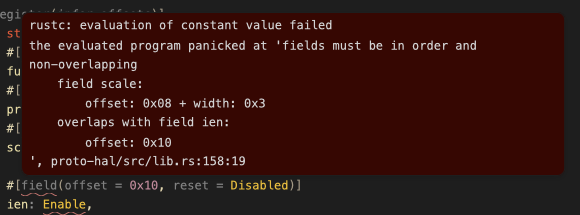
This error is fabricated for demonstrating span redirection.
Public Contributions
stm32g4xx-hal is migrating to the new PAC generated with the new field accessor methods we introduced in update 0 which allowed for the merge of the fully type-enforced CORDIC interface outlined in this blog post. PR
darling did not correctly parse
meta words for structs that implement Default. PR
All code for this project now resides in the proto-hal crate here.
Next Up
- How are inter-register entitlements and effects to be implemented? Should some kind of register-coupling concept be introduced?
- Using constant evaluation to conduct static analysis.
TransitionBuilder- lossy transitions (when a field is isolated)